 PredictionToolkit
What is CME FedWatch?
The framework uses 30-Day Fed Funds futures rather than prediction-market prices. Its probabilities follow CME’s methodology and do not represent a forecast issued by the Federal Reserve. The distinction matters when comparing numbers derived from different instruments.
Begin with the meeting date, starting rate and target-rate range. A contract about the size of a rate change is not automatically equivalent to a particular target range. Read the methodology and check timestamps before interpreting a difference between markets.
Who it is for
- Macro researchers investigating expectations around an FOMC decision.
- Traders comparing a prediction-market contract with a futures-based reference.
Features and coverage
- Futures-implied probabilities
Explore CME’s framework for deriving FOMC outcome probabilities from 30-Day Fed Funds futures.
- Meeting and rate-range context
Use the meeting date and target-rate outcomes to define what is being compared.
- Calculation guidance
The public page links to the official methodology and user guide. API access is presented separately.
Workflows with CME FedWatch
Map an outcome
Select the same FOMC meeting as the contract under research. Map a rate-change outcome to the same starting rate and target range before comparing probabilities.
Investigate differing values
Check both timestamps and CME’s calculation method. Interpret the difference with the instruments and outcome definitions in view, rather than assuming the values measure an identical event.
Pricing and total cost
The public FedWatch information page can be accessed. This does not establish commercial API rights or a market-data licence; those separate terms were not confirmed.
Access: The interactive tool is embedded through CME’s provider. Methodology and user-guide links are available on the public page.
Getting started
Before you start: The probabilities depend on CME’s futures-based methodology and are neither official Fed forecasts nor guaranteed outcomes.
- Open the official FedWatch page and read the user guide.
- Identify the FOMC meeting and target-rate range relevant to your question.
- Check the calculation method and data timestamps before comparing with another market.
Use the provider’s embedded tool for the interactive view; the public information page is not evidence of an unrestricted data API.
Useful links
What to check
- The probabilities depend on CME’s futures-based methodology and are neither official Fed forecasts nor guaranteed outcomes.
- Embedded data delivery has not been benchmarked. Do not infer latency or commercial data rights from public page access.
A closer look
Ratings & reviews
User reviews 0
The main score switches to user ratings after 5 published reviews.
A specific example helps the next person choose the right tool.
Related tools
Browse category

Economic-data search and history for checking the precise measure behind a macro contract.
- Access Web
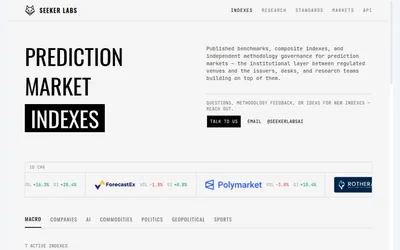

Explore themed prediction-market benchmarks and their construction, keeping consensus, disagreement and venue activity distinct.
- Access Web


Follow themes across event contracts using constructed indices, reference rates, research dashboards and market briefings.
- Access Web · API · Email
Frequently asked questions about CME FedWatch
Does the Federal Reserve publish these probabilities?
No. CME derives them from 30-Day Fed Funds futures using its own methodology.
Can a target-rate range be compared directly with a rate-change contract?
Only after both are mapped to the same starting rate, meeting and outcome definition.
Does access to the public page include a commercial API licence?
No such entitlement was established. Commercial API and market-data terms are separate from access to the information page.
Where is the interactive view?
It is embedded through CME’s provider; the surrounding page supplies the methodology and user guide.