 PredictionToolkit

What is ProbSee?
The signal interface groups public activity by type and strength, with wallet counts, trade counts and accumulated notional. A cluster is a grouping of observed activity, not proof that wallets share an owner, coordinate or possess private information. Notional is also distinct from investor count and net exposure.
Research adds supporting and opposing arguments, source context, model value estimates and a clause audit. That helps separate an expected event from the exact authority, threshold and deadline named in the contract. Homepage examples do not replace the current Signals wire.
Who it is for
- Researchers investigating clusters of public trades.
- Users pressure-testing a thesis before taking a position.
- Readers checking whether an expected event matches settlement wording.
Features and coverage
- Signal filters and explanations
Choose strength and types such as whale, cluster, momentum or news, then open the signal explanation for detection context.
- Cluster and wallet detail
Inspect wallet counts, trade counts, notional, outcome and direction, and move among smart trades, whales, news and rankings.
- Thesis pressure-test
Examine supporting arguments and the strongest opposing evidence rather than relying on a signal alone.
- Resolution-clause audit
Read the settlement condition alongside the thesis and compare its authority, threshold and deadline.
- Model estimates and research capacity
Compare estimated value with market pricing and choose a credit/concurrency tier that suits repeated research.
Workflows with ProbSee
Investigate a cluster
Check the exact outcome and direction and inspect the constituent activity without assuming common wallet ownership.
Challenge a thesis
Submit the reasoning and examine the strongest counterargument and its sources.
Check the settlement match
Compare the named authority, threshold and deadline with the event you expect to occur.
Pricing and total cost
Free, Pro and Max combine monthly research credits with different concurrency and model access.
Free
$0
- 100 credits/month
- 1 concurrent task
- Free-tier models
Pro
$20/month
- 4,000 credits/month
- 5 concurrent tasks
- All listed model tiers and priority processing
Max
$100/month
- 20,000 credits/month
- 10 concurrent tasks
- Highest processing priority
Access: Annual billing advertises approximately 17% savings.
Getting started
Before you start: Signal notional is not a count of distinct investors or their net exposure.
- Open the populated Signals page and filter by type and strength.
- Inspect the signal’s affected outcome, direction and explanation.
- Use the thesis and clause research tools to test the interpretation.
- Review credit and concurrency allowances before larger research runs.
A public-activity cluster does not establish coordination or private information.
Useful links
What to check
- Signal notional is not a count of distinct investors or their net exposure.
- Homepage examples are not a substitute for the current signal wire.
- Credit and concurrency limits shape repeated analysis.
A closer look
Ratings & reviews
User reviews 0
The main score switches to user ratings after 5 published reviews.
A specific example helps the next person choose the right tool.
Related tools
Browse category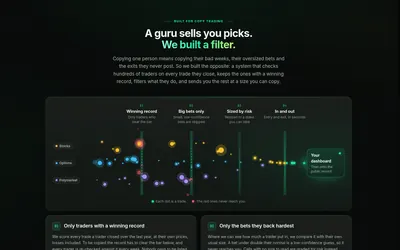

Follow filtered entries and exits, compare playbooks and inspect the public record behind a signal.
- Access Web
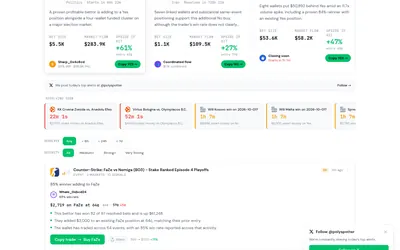
Follow selected Polymarket trades into wallet records, grouped events and cross-market positions.
- Access Web · Email
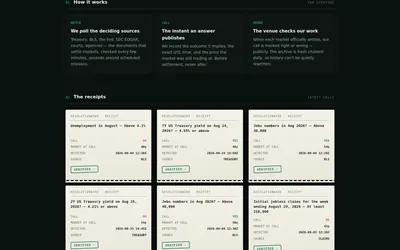
Document-based market research with deciding-source maps, timestamped receipts and a public record of settled calls.
- Access Web
Frequently asked questions about ProbSee
Can I narrow the signals?
Yes. Type and strength filters let users narrow the wire before opening the explanation.
Does it review resolution wording?
Yes. Clause review is part of the research workflow, alongside thesis evidence and opposing arguments.
What does Pro cost?
The published Pro tier is $20/month; its credits and concurrency differ from Free and Max.