 PredictionToolkit
What is prediction-market-backtesting?
Choose PMXT or Telonex loading paths and preserve the selected schema, local layout and time range. Cached and materialized staging avoids repeated acquisition. Book deltas and trade ticks feed the event-driven simulation, where fees, latency and passive queue position remain explicit assumptions.
Runnable public historical replay is focused on Polymarket. Kalshi code is research and fee-model plumbing; Limitless and Opinion remain planned. A separate BTC live-data sandbox is not the historical runner, and sandbox or live operations can require different accounts.
Who it is for
- Reusable Python replay research.
- Comparing parameters across markets.
- Inspecting execution assumptions and reports.
Features and coverage
- NautilusTrader
Use the underlying event-driven simulation framework.
- Book replay
Combine supported book deltas and trade ticks.
- Vendor loaders
Documented PMXT and Telonex paths.
- Cached staging
Reuse local and materialized data.
- Joint portfolios
Model several markets with shared capital assumptions.
- Optimization
Explore parameters with supported samplers.
- Reports
Equity, drawdown, fills, allocation, returns and scoring charts.
- BTC sandbox
Separate live-data sandbox experimentation.
Workflows with prediction-market-backtesting
Reproduce an experiment
Fix vendor, time range, runner and parameters; retain execution assumptions with results.
Compare parameters
Warm the cache, run the sampler and inspect unusual fills and drawdowns alongside return.
Test a portfolio
Use the joint runner to model capital allocation across markets together.
Pricing and total cost
The public repository has component-specific license notes. Data vendors, compute and separately enabled live operations have their own costs.
Getting started
Before you start: Limitless and Opinion are planned integrations.
- Follow current setup and runner-contract documentation.
- Select a supported Polymarket vendor.
- Acquire or locate a small data window.
- Run an example and inspect its report.
- Specify fees, latency and passive-order assumptions.
- Expand after single-market replay works.
Kalshi research and fee-model components are not a public runnable backtest path.
Useful links
What to check
- Limitless and Opinion are planned integrations.
- Vendor schema and file layout must match the loader.
- Queue position and latency are simulation assumptions.
- Sandbox and live runners differ from historical replay and can need different accounts.
A closer look
Ratings & reviews
User reviews 0
The main score switches to user ratings after 5 published reviews.
A specific example helps the next person choose the right tool.
Related tools
Browse category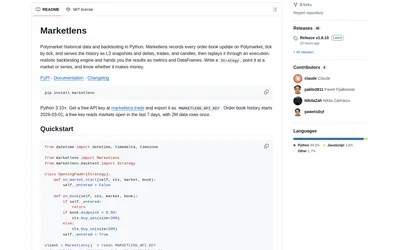

Compare fast bar experiments with detailed L2 replay, reusing downloaded history between strategy changes.
- Language Python
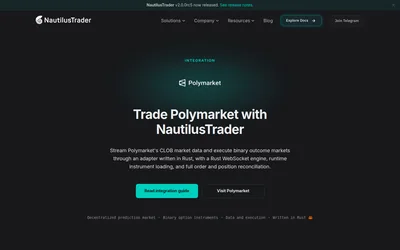

Receive native market events and manage signed orders, reconciliation and resolution in one trading framework.
- Language Python · Rust
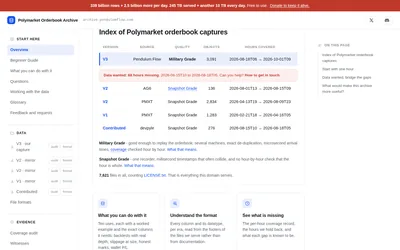

Download earlier Polymarket book captures from the public mirror and inspect the coverage of each era.
Frequently asked questions about prediction-market-backtesting
Can I immediately run a Kalshi backtest?
No. The README separates its research plumbing from a runnable public path.
Are notebooks supported?
Yes. Notebook runners are documented.
Can markets share capital?
Yes. Joint multi-market runners are supported.
Why can vendor results differ?
Coverage, event ordering, depth and loader assumptions vary.