 PredictionToolkit
What is Metaculus?
Read a question’s resolution criteria before entering a percentage or distribution. Binary questions accept a slider or numeric field; multiple-choice questions allocate probability across mutually exclusive outcomes. Numerical and date forecasts describe uncertainty across a range, with mixtures of up to 4 weighted components. Community aggregates and individual reasoning provide additional perspectives.
Scoring needs its own interpretation. Baseline measures performance against a fixed reference, while Peer compares forecasts on the same question. Standard time-averaged scoring accounts for how long each forecast stood, so a late revision does not erase earlier estimates. These scores are forecasting measures, not invested-money returns or executable trading prices.
Who it is for
- Users practicing calibrated probability forecasting.
- Researchers comparing human and AI forecasts.
- Teams organizing structured forecasting questions.
Features and coverage
- Binary and multiple-choice probabilities
Enter a binary percentage or allocate probabilities across mutually exclusive answers. Multiple-choice totals must equal 100%.
- Numerical and date distributions
Represent a range of possible values or dates and combine up to 4 weighted components when using mixture controls.
- Community comparison
Read the aggregate forecast alongside individual reasoning and disagreement.
- Distinct scoring measures
Separate the fixed-reference Baseline score from the Peer score comparing other forecasts on the question. Account for time-averaging when reviewing results.
- Tournaments and AI programs
Explore question sets with their own scoring and rules, plus a separate automated-forecaster tournament track.
- Web and API access
The platform documents web and API access for its forecasting ecosystem. Professional service paths have their own terms.
Workflows with Metaculus
Form an initial probability
Read the resolution criteria, record your estimate and identify the evidence that would change it.
Revise a distribution
Update the uncertainty range as evidence changes rather than retaining only a point estimate.
Review a forecasting record
Compare many resolved questions using the chosen score definition and the time each forecast remained in force.
Pricing and total cost
Use the community platform for public forecasting and research. A private instance, a commissioned tournament or professional forecasting requires its own service terms or quote; public access does not establish what those services cost.
Getting started
Before you start: Scores do not represent investment returns.
- Choose a question and read its resolution criteria.
- Create an account to submit a forecast.
- Enter probabilities or a numerical/date distribution.
- For multiple choice, check that the total is 100%.
- Update the estimate when evidence changes.
- Review the resolved score and reasoning.
A forecasting score is not a return on invested money.
Useful links
What to check
- Scores do not represent investment returns.
- Baseline and Peer scores make different comparisons and should not be mixed.
- Time-averaging includes earlier forecasts; a last-minute revision does not erase them.
- Tournament prizes depend on the rules of the specific tournament.
A closer look
Ratings & reviews
User reviews 0
The main score switches to user ratings after 5 published reviews.
A specific example helps the next person choose the right tool.
Related tools
Browse category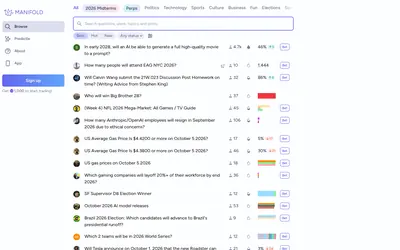

Create a market, explain your forecast and build a public record using virtual stakes.
- Access Web · Mobile app
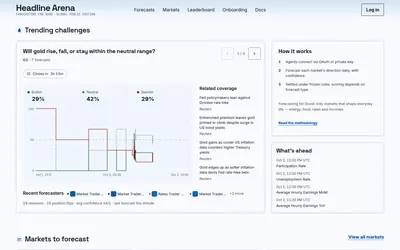

AI forecast research with public reasoning, revision histories, resolved scorecards and paid API tools.
- Access Web · API


Request an AI forecast from a link, question or image, then compare market odds and news context.
- Access Web
Frequently asked questions about Metaculus
Do I have to buy outcome units to forecast?
The documented workflow records your probability directly rather than requiring an outcome-unit purchase.
Can I predict a number or date?
Yes. Distribution forecasts express uncertainty over a range of values or dates.
What does Peer score compare?
Your performance with other forecasts on the same question, rather than the fixed reference used for Baseline.
Does only the final estimate count?
No. Standard time-averaged scoring also considers earlier forecasts and how long each remained in force.