 PredictionToolkit
What is SEDA?
An Oracle Program defines deterministic retrieval and transformation logic for an external-data pipeline. Developers build the program to WASM, test locally, deploy it to the SEDA network and retain its program ID. Data Proxies provide a dedicated connector for private or proprietary APIs, keeping provider-key access in that layer rather than distributing the key to every caller. Private-source credentials and usage rights are still required.
Deployment and execution are separate tasks. Fast executes an existing program through API-oriented delivery; it does not upload a new one. On-chain consumption uses Core and a supported prover deployment, with a documented Hardhat path for EVM integration. The documentation covers API/WebSocket interfaces, WASM and smart contracts. For a prediction-market data pipeline, define the source, timeout and resolution logic explicitly and check prover availability on the target chain.
Who it is for
- Builders designing pipelines for external event data.
- Developers connecting private or licensed data providers.
- Agent teams integrating structured oracle results into applications.
Features and coverage
- Oracle Programs
Package deterministic data retrieval and transformation logic.
- Source connections
Connect public or private data feeds, APIs and documented source paths.
- Data Proxies
Keep API-key access in a dedicated connector for the private source.
- Local build and testing
Compile the starter program to WASM and test it before deployment.
- Program deployment
Upload the program to the SEDA network and obtain its ID.
- Fast execution
Execute an already deployed program through API-oriented delivery.
- On-chain results
Use Core and a prover deployment supported on the target chain.
- EVM integration
Follow the documented Hardhat integration route.
- Agent runbooks
Use task-specific fetching, deployment and execution guides.
Workflows with SEDA
Build an outcome-data pipeline
Define the source and output schema, test edge cases locally and deploy the Oracle Program.
Connect a licensed API
Create a proxy route and retain the provider credential in the documented proxy layer, with the required data usage entitlement.
Consume the result
Choose Fast for application delivery, or verify target-chain prover support before on-chain consumption.
Pricing and total cost
The reviewed documentation does not give a universal flat subscription for oracle integration. Costs depend on the execution path, network usage and any separate data-provider subscription.
Getting started
Before you start: Fast does not deploy a new program.
- Choose the source type you need.
- Read the relevant developer or agent module.
- Build and locally test a minimal Oracle Program.
- Configure a proxy if private-source access requires one.
- Deploy the program and keep its ID.
- Choose Fast or the on-chain result-consumption path.
Fast executes existing programs; deployment is a separate step.
Useful links
What to check
- Fast does not deploy a new program.
- Private APIs still require their own credentials and usage rights.
- On-chain integration depends on prover availability for the target chain.
- Prediction-market use needs explicit source, timeout and resolution logic.
- Network and upstream-data costs are specific to the integration.
A closer look
Ratings & reviews
User reviews 0
The main score switches to user ratings after 5 published reviews.
A specific example helps the next person choose the right tool.
Related tools
Browse category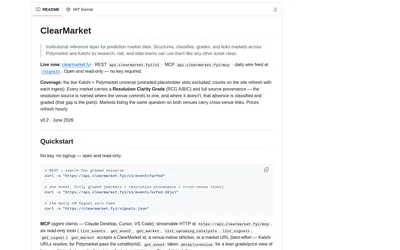
Compare resolution sources and clarity grades, then follow question-level links across Polymarket and Kalshi.
- Access Web · API · MCP
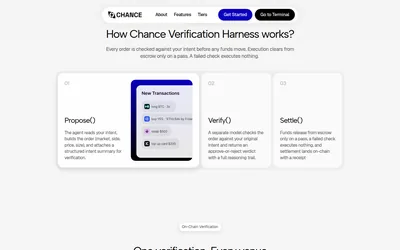

A separate verification step for matching proposed trading actions to their original instructions.
- Access Web · API · MCP
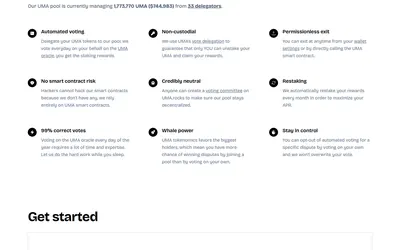

Manage UMA voting delegation, rewards and individual dispute overrides from a web dashboard.
- Access Web
Frequently asked questions about SEDA
What does a Data Proxy do?
It connects a private or proprietary source using that provider’s access key.
Can Fast upload a program?
No. Deploy the program separately before executing it through Fast.
Can I test before deployment?
Yes. The runbooks describe local build and test steps.
Is SEDA a retail trading terminal?
No. It is developer infrastructure for data and oracle workflows.