 PredictionToolkit

What is Chance?
An agent can misunderstand a market, choose the wrong outcome or propose a different size from the instruction. Chance places a distinct verifier after the proposal, comparing market, side, price and size as well as outcome and resolution-source alignment. The resulting reasoning gives a team something concrete to inspect when an action is rejected.
Light returns a decision without moving funds or transferring custody. The fuller product describes escrow-gated settlement after a passing check, while MCP and JSON-RPC provide integration surfaces. Chance AI and a terminal offer agent-strategy and manual interfaces. The ecosystem list names Polymarket, Kalshi, Predict.fun, Opinion, Limitless, Myriad and Hyperliquid; the custody and execution boundary still depends on the selected architecture.
Who it is for
- Developers building agents that can propose and submit orders.
- Teams needing an inspectable decision before execution.
- Users evaluating how verification fits into an agent trading workflow.
Features and coverage
- Structured intent comparison
Compare the proposed market, side, price and size with the original instruction, including outcome and resolution-source alignment.
- Separate verifier and reasoning
A model distinct from the proposing step returns an approve/reject result with an explanation that can be retained for review.
- Light verification
Call chance.verify(tx, intent) for a verdict and reasoning without moving funds or transferring custody.
- Integration surfaces
Connect through the listed MCP and JSON-RPC interfaces.
- Execution gating
The Full design describes escrow-gated settlement only after a passing verification. Inspect its custody and execution architecture before choosing it.
- Application interfaces
Chance AI and the terminal provide agent-strategy and manual ways to interact with the product.
Workflows with Chance
Review before signing
Make signing conditional on the verifier's expected decision. To obtain that decision, supply the proposed transaction together with the original user instruction, so the check evaluates the proposal against what was actually requested.
Investigate a rejection
Compare the proposal’s market, outcome, amount and resolution source with the original request, using the returned reasoning to locate the mismatch.
Choose the boundary
Use Light when only a decision is required. If settlement must be gated, examine the fuller execution architecture and its custody responsibilities.
Pricing and total cost
The website names Light, Full and RPC integration depths but does not publish a numeric price schedule.
Getting started
Before you start: A matching intent is not a profitability forecast or a guarantee of transaction safety.
- Open the official integration documentation.
- Choose a verdict-only or execution-integrated approach.
- Define the original intent and structured order fields.
- Connect through MCP or JSON-RPC.
- Inspect reasoning from representative requests without funding them.
- Then connect the selected execution path.
Intent verification checks compliance with the instruction; it does not establish whether the trade will be profitable.
Useful links
What to check
- A matching intent is not a profitability forecast or a guarantee of transaction safety.
- Light returns a verdict and does not move funds.
- Custody and execution responsibilities differ across integration depths.
A closer look
Ratings & reviews
User reviews 0
The main score switches to user ratings after 5 published reviews.
A specific example helps the next person choose the right tool.
Related tools
Browse category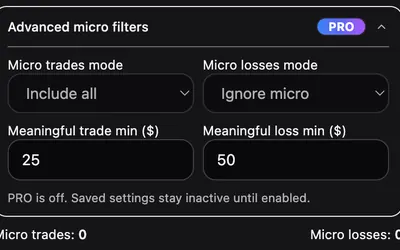

Set session budgets and pause rules around Polymarket, then inspect trading-behavior signals in a browser dashboard.
- Access Browser extension
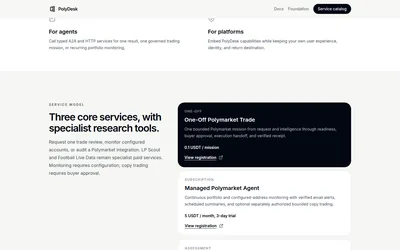

Embed bounded trade requests, recurring monitoring and integration assessments through typed agent services.
- Access API · Email
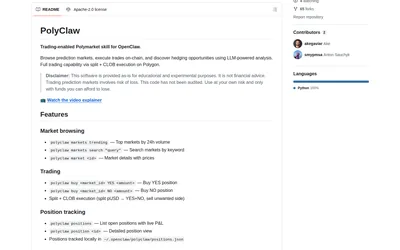
An OpenClaw skill connecting discovery, wallet commands, local positions and logical market-pair analysis.
- Access CLI
Frequently asked questions about Chance
What does Light return?
A verification verdict and its reasoning. Light does not move funds or transfer custody.
Does it check prediction-market details?
The product explicitly includes market, outcome and resolution-source alignment, alongside side, price and size.
Can an agent connect over MCP?
Yes. The listed integration surfaces include MCP and JSON-RPC.
Does approval predict the winning outcome?
No. Approval concerns whether the proposed action follows the original intent, not whether its prediction is correct or profitable.