 PredictionToolkit
What is Polyrust?
The nniel-ape repository documents an event-driven engine, strategy traits, execution backends and local persistence, plus historical replay, parameter sweeps and an Axum/HTMX monitoring dashboard. It separates simulated execution from live CLOB integration and describes local or container deployment with Rust 1.85 or later.
The README warns that a missing configuration file can leave the Rust structure’s default in live mode. Set POLY_PAPER_TRADING=true explicitly for simulation and validate the configuration before considering live credentials. This review covers the repository snapshot of 26 October 2026; it did not run or security-audit the code. A redistribution licence and future maintenance cadence were not established.
Who it is for
- Rust developers building event-driven strategy infrastructure.
- Researchers studying paper execution and historical replay models.
Features and coverage
- Strategy traits and registration
Implement the documented strategy trait and register it with the engine, tracing how market events become strategy actions.
- Paper and live execution backends
The architecture separates simulated execution from live CLOB integration; configuration must deliberately select the intended mode.
- Backtests and monitoring
Study documented replay, parameter-sweep and persistence components alongside the Axum/HTMX monitoring dashboard.
Workflows with Polyrust
Trace the architecture
Follow market events through the engine to a strategy and examine how the execution backend processes its actions.
Select simulation explicitly
Inspect configuration and set POLY_PAPER_TRADING=true before evaluating a strategy or replay output; do not assume missing configuration selects paper mode.
Pricing and total cost
Reading the public repository is distinct from paying to run an adaptation. The reviewed record does not establish a hosted subscription; infrastructure, data and live-trading costs need separate consideration.
Access: The README specifies Rust 1.85 or later and local or container deployment. Public source access does not establish a redistribution licence.
Getting started
Before you start: Missing configuration can fall back to live mode; explicitly set POLY_PAPER_TRADING=true for simulation.
- Read configuration and execution-backend documentation.
- Inspect the source and Rust 1.85-or-later requirements in an isolated development environment.
- Set POLY_PAPER_TRADING=true explicitly and validate simulation behaviour before considering live credentials.
A Rust 1.85-or-later local or container environment is required; the configuration fallback must be understood before running code.
Useful links
What to check
- Missing configuration can fall back to live mode; explicitly set POLY_PAPER_TRADING=true for simulation.
- No code, strategy or live backend was executed or security-audited in this review.
- Sample strategies and replay output are not independently validated profitable performance.
- Redistribution licensing and a future maintenance cadence were not established.
A closer look
Ratings & reviews
User reviews 0
The main score switches to user ratings after 5 published reviews.
A specific example helps the next person choose the right tool.
Related tools
Browse category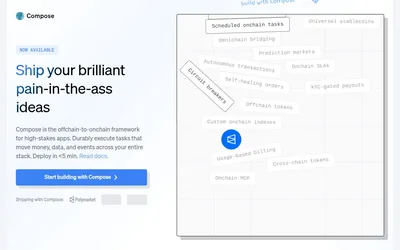

A framework for durable TypeScript tasks spanning external services and blockchains, with market and copy-trader solution guides.
- Access TypeScript · Cloud
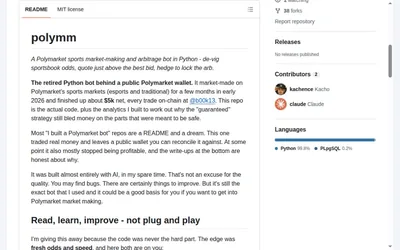
Educational source code and a retrospective on a retired Polymarket sports market-making bot.
- Access Python · Source code
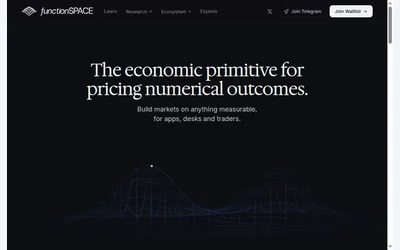

Compare yes/no, range, linear and custom payoff shapes through a public prototype for market-design research.
- Access Web · Developer package
Frequently asked questions about Polyrust
Does missing configuration always mean paper mode?
No. Without a configuration file, the Rust structure’s fallback can select live mode. Treat simulation as an explicit configuration choice and verify it before using live credentials.
Are its sample strategies proven profitable?
No independent performance validation was performed. Treat them as code to study and test.
Is there a hosted subscription?
None was established by the review. The repository is public; hosting, data and live-trading expenses are separate.
What environment is documented?
Rust 1.85 or later, deployed locally or in a container according to the README.