 PredictionToolkit
What is polymm?
Trace odds de-vigging, event matching and quote logic, then inspect the paths for partial fills, lost edge and residual exposure. The author explains damage from stale odds and adverse selection: an apparently hedged trade can retain directional risk when a leg fails. This makes the repository most useful as engineering study material.
The MIT release includes wallet-analysis scripts but omits private scrapers and the private odds pipeline. The author’s newer Rust implementation is also outside the release. A research adaptation needs its own infrastructure, database schema and odds-data source; the included public API route may incur data costs.
Who it is for
- For developers studying sports market-making architecture and researchers learning from documented execution failures.
Features and coverage
- Odds and quoting pipeline
Study bookmaker-margin removal, event matching and limit-order logic in the published Python code.
- Hedge failure paths
Inspect partial-fill, edge-loss and residual-exposure paths alongside the author’s account of stale odds and adverse selection.
- Public-wallet analysis scripts
Use the documented wallet scripts as a research reference rather than a validated portfolio-accounting service.
Workflows with polymm
Trace a documented failure
Read the retrospective and retirement notes, then follow the relevant matching or hedge path in the repository.
Assess an adaptation’s dependencies
Identify odds provider, database schema and infrastructure requirements and test assumptions before adapting code for local research.
Pricing and total cost
The source is MIT-licensed, with infrastructure and an odds-data source supplied by the user. The included public API path can incur data fees; this is developer source code rather than a hosted service.
Getting started
Before you start: Private scrapers and the Rust successor are omitted. Historical profit claims are the author’s account, not independently verified results or evidence for unattended live suitability.
- Read retirement and failure-analysis notes before inspecting data, matching and hedge code.
- Identify missing private components and review dependencies and assumptions before a local research adaptation.
The Python version is retired and is developer source, not a hosted trading service.
Useful links
What to check
- Private scrapers and the Rust successor are omitted. Historical profit claims are the author’s account, not independently verified results or evidence for unattended live suitability.
A closer look
Ratings & reviews
User reviews 0
The main score switches to user ratings after 5 published reviews.
A specific example helps the next person choose the right tool.
Related tools
Browse category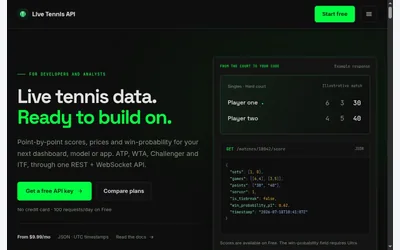

Research tennis with scores, fixtures, history and odds; advanced delivery and model fields depend on the plan.
- Access REST API · WebSocket · MCP


Compare yes/no, range, linear and custom payoff shapes through a public prototype for market-design research.
- Access Web · Developer package
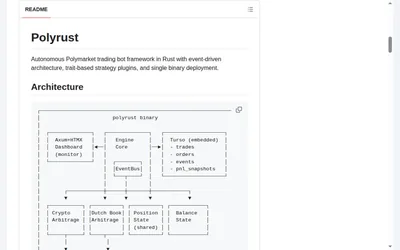
A Rust framework reference for strategies, paper execution, replay and monitoring, with a material configuration caveat.
- Access Rust · Self-hosted
Frequently asked questions about polymm
Is the newer Rust implementation included?
No. This release is the retired Python version, and the private odds pipeline is not included either.