 PredictionToolkit

What is Polymarket Agents (GitHub)?
The modular components show how an agent can gather events, markets and outside research before forming a response or account action. Gamma and Polymarket wrappers provide market context, Pydantic supplies shared objects, and Chroma supports embedded research storage. The documented access paths include Python, CLI and Docker.
Treat the repository as a development reference. Its README targets Python 3.9 and older client conventions, and the funding example uses legacy collateral terminology. Compare signing, funding and account handling with current official wallet and client documentation before live integration. The trade application is an execution entry point, not a read-only research example.
Who it is for
- Developers studying prediction-market agent architecture.
- Researchers combining market data with retrieved news.
- Teams extending a Python agent prototype.
Features and coverage
- Market connectors
Read events and markets through Gamma and Polymarket wrappers.
- Typed data
Represent markets, events and trades with Pydantic models.
- Retrieval workflows
Use local or remote retrieval-augmented research utilities.
- Vector storage
Store embedded research material through the Chroma integration.
- External inputs
Connect supported betting, news and web-search sources.
- Prompt tools
Organize interactions with language models around market research.
- CLI access
Explore markets, news and stored data, and inspect the supported trading commands.
Workflows with Polymarket Agents (GitHub)
Build a research prototype
Fetch a small market set, retrieve relevant external material and inspect the evidence passed to the model.
Extend a connector
Add or replace a source while preserving the shared market and trade models.
Trace the execution boundary
Follow a model result through to an order request. Replace legacy account handling with the current venue integration wherever required.
Pricing and total cost
The source is MIT-licensed. Model calls, data-provider access, hosting and venue transactions have separate costs; the code license does not include those services.
Getting started
Before you start: The funding example uses legacy collateral terminology; use current official account guides for live setup.
- Create an isolated environment matching the repository’s documented Python version.
- Install dependencies and configure the relevant provider credentials.
- Read a small market list through the CLI.
- Inspect retrieved material and prompt outputs before enabling account actions.
- Compare legacy signing and funding instructions with current official client documentation.
The README targets Python 3.9 and older client conventions, so current compatibility needs development review.
Useful links
What to check
- The funding example uses legacy collateral terminology; use current official account guides for live setup.
- The trade application can execute account actions and is not a read-only example.
- The framework requires configuration and development; it is not a turnkey hosted assistant.
A closer look
Ratings & reviews
User reviews 0
The main score switches to user ratings after 5 published reviews.
A specific example helps the next person choose the right tool.
Related tools
Browse category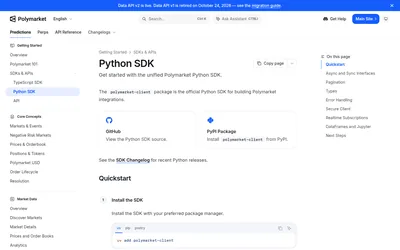

Typed sync and async clients for scripts, notebooks, account workflows and real-time subscriptions.
- Language Python
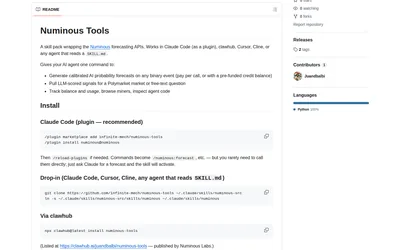
Request forecasts and market evidence from an agent while tracking separately metered API usage.
- Language Python
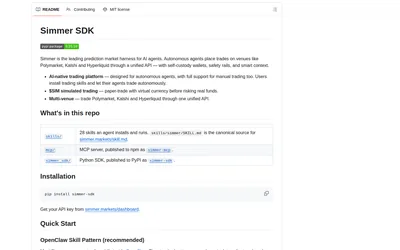

Develop agent strategies with research, paper trading, replay and supported live integrations.
- Language Python
- Access CLI
Frequently asked questions about Polymarket Agents (GitHub)
Is it a ready-made Telegram bot?
No. It is a Python framework with a CLI and application examples.
Can I replace the research database?
Its modular structure permits other vector-store implementations.
What does Chroma do?
It supports vectorizing and retrieving research material.
Should I copy the funding example directly?
Use current official wallet and client guides when implementing live account access, and reconcile the repository’s older instructions first.