 PredictionToolkit

What is OrderbookTrade?
Polymarket is explicitly listed as live. Kalshi is planned and Rain is integrating, so they should not be treated as equivalent current routes. A common execution interface also does not remove venue-specific funding and settlement handling.
Review how strategy outputs map to orders, inventory skew and exposure controls before production routing. For a platform launch, matching, initial capital and operational ownership are separate parts of the engagement. Published production statistics are provider-reported examples rather than an independently audited service-level agreement.
Who it is for
- Integrating execution for an agent.
- Launching an order book for a prediction platform.
- Evaluating inventory and risk tools for market making.
Components and integration requirements
- REST and WebSocket layer
Connect order actions and live feeds through a common interface.
- CLOB matching engine
Evaluate matching infrastructure for a new prediction platform.
- Initial liquidity support
Discuss market-making support as part of a platform engagement.
- Inventory controls
Manage inventory skew across markets.
- Risk monitoring
Inspect position exposure alongside execution.
- Agent compatibility
The provider lists compatibility with OpenClaw.
- SDK documentation
Review the execution abstraction before building an integration.
Infrastructure workflows
Integrate an agent
Map strategy outputs to the documented order interface and verify the behavior of the required venue.
Evaluate a platform launch
Discuss matching, initial capital and operational ownership as separate parts of the engagement.
Review market making
Inspect inventory limits, quote behavior and settlement handling before production routing.
Pricing and total cost
No public numeric tariff is displayed. Access and platform or liquidity engagements use the request-access or contact flow.
Deployment and integration
- Read the API and architecture documentation.
- Confirm the required venue's actual integration status.
- Request access for the intended use case.
- Configure order and inventory limits.
- Test the complete order lifecycle before production deployment.
Useful links
What to check
- Rain is labelled integrating.
- Shared execution still needs venue-specific funding and settlement handling.
- Provider-reported production statistics are not an independently audited service-level agreement.
- Commercial prices and access terms require direct inquiry.
A closer look
Ratings & reviews
User reviews 0
The main score switches to user ratings after 5 published reviews.
A specific example helps the next person choose the right tool.
Related tools
Browse category

Shared liquidity, event data and developer tools for independent prediction and sports-betting applications.
- Access API

A credit layer for adding quoted Polymarket leverage to an existing trading interface.
- Access API · CLI
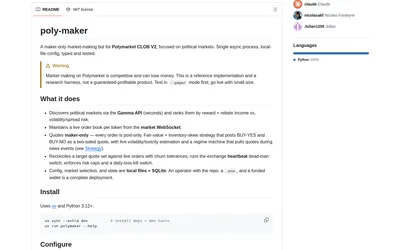
Run inventory-aware maker quotes with local settings, exposure caps and a paper pipeline using live market data.
- Trading mode Paper · Live automation
- Access CLI
Frequently asked questions about OrderbookTrade
Which venue is explicitly live?
Polymarket.
Is Kalshi already supported?
The ecosystem section labels it planned.
Is this only a retail terminal?
No. The stated focus is platforms, agents and market makers.
Are prices public?
The public page does not display a numeric schedule.