 PredictionToolkit

What is Marketlens?
The archive starts on March 1, 2026 for covered markets; check each market’s actual coverage rather than treating that date as continuous history for everything. Strategy callbacks expose book updates, trades, fills, rejects and market boundaries, with a simulated account for balances, positions and order controls.
Exports and replays need two kinds of budgeting: data allowance and execution assumptions. Request a dry-run quote before a large export, and specify latency, queue and fill behavior before judging a strategy. Inspect effective coverage because a history-store failure can skip a market during a backtest.
Who it is for
- Quant researchers studying execution and depth.
- Developers building trade and candle datasets.
- Teams planning large historical exports.
Features and coverage
- Historical market data
Retrieve L2 book depth, trades and candles for covered markets.
- Python callbacks
React to book updates, trades, fills, rejects and market boundaries in your strategy.
- Simulated account controls
Inspect balances and positions, manage orders and use split/merge operations.
- Export estimates
Quote a large export before running it. Downloading the same completed export again does not incur new row charges.
- Cursor pagination
List endpoints use opaque cursors; the SDK can paginate automatically. Cursors expire after 24 hours.
- Explicit execution assumptions
Configure latency, queue and fills rather than assuming every displayed price is tradable.
Workflows with Marketlens
Start with one market
Check coverage, fetch history and replay a small strategy with documented fill and latency settings. Inspect fills and positions before expanding the test.
Budget a research dataset
Choose markets and dates, request a dry-run estimate and compare it with your row allowance. Retain the finished export for repeatable local analysis.
Pricing and total cost
Free supplies 2 million rows once and a recent seven-day market-access window. Pro costs US$39/month; Scale costs US$199/month.
Free
US$0
- 2 million rows once.
- Recent seven-day market-access window.
Pro
US$39/month
- 5 billion rows/month.
- 3,600 requests/minute.
- 5 API keys.
- Full archive.
Scale
US$199/month
- 50 billion rows/month.
- 10,800 requests/minute.
- 25 API keys.
- Full archive.
Fees and usage costs
- Unused paid-plan rows roll over for one month.
- A separate daily request-unit budget applies; limits are shared across a user’s keys.
Getting started
Before you start: Check actual coverage per market; the archive start date is not universal continuous history.
- Create an API key in the Marketlens console.
- Install the marketlens Python package or use REST.
- Set MARKETLENS_API_KEY and request a small market list.
- Check coverage and quote an export before fetching history.
- Replay one market and inspect fills and simulated account state.
The archive start date does not guarantee continuous coverage for every market.
Useful links
What to check
- Check actual coverage per market; the archive start date is not universal continuous history.
- Cursors expire after 24 hours.
- A history-store failure can skip a backtest market.
- Queue, latency and fill settings materially affect replay results.
A closer look
Ratings & reviews
User reviews 0
The main score switches to user ratings after 5 published reviews.
A specific example helps the next person choose the right tool.
Related tools
Browse category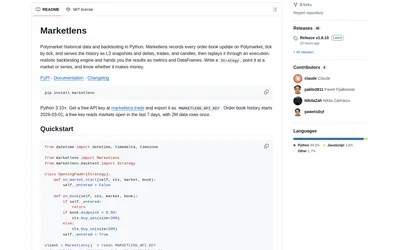
Compare fast bar experiments with detailed L2 replay, reusing downloaded history between strategy changes.
- Language Python
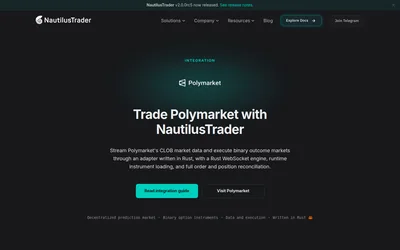

Receive native market events and manage signed orders, reconciliation and resolution in one trading framework.
- Language Python · Rust
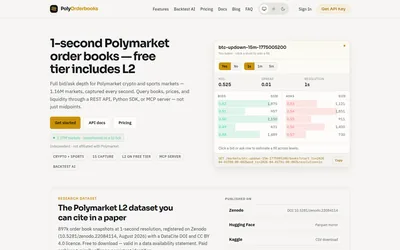

Query historical books at 250 ms intervals or replay supported crypto strategies with depth-based fills.
- Access Web · API · MCP
Frequently asked questions about Marketlens
Why use L2 history instead of a chart?
Book depth helps study liquidity and fills; a price chart usually summarizes prices.
Can I estimate row usage first?
Yes. Use the documented dry-run quote before starting an export.
Can I replay my own Python strategy?
Yes. The engine supplies strategy callbacks and simulated account controls.