 PredictionToolkit
What is Weather Edge?
The method combines 31 GFS and 51 ECMWF ensemble members, then applies an NWS point-forecast adjustment and city-specific uncertainty scaling. Those 82 inputs are members of two ensemble families, not 82 independent model families. A signal must pass the stated 8-percentage-point edge floor and a liquidity filter before the daily summary.
The page lists scan cycles at 5, 7 and 9 AM Central Time. Its small, dated results table includes a restricted high-confidence subset, a fuller calibration sample and pending entries; read these separately rather than treating the table as a complete current performance series. The reviewed offering is weather research and email signals for Kalshi, not native Polymarket execution or a trading terminal.
Who it is for
- Researchers learning how ensemble forecasts map to contracts.
- People following US-city temperature markets.
- Readers comparing model disagreement with market prices.
Features and coverage
- Ensemble inputs
Combine 31 GFS and 51 ECMWF members from the two named ensemble families.
- Bias adjustment
Use NWS point forecasts in the described correction.
- City calibration
Apply uncertainty scaling specific to each covered city.
- Signal threshold
The described minimum edge is 8 percentage points, not a relative percentage return.
- Liquidity filter
Exclude thin markets according to the model’s stated rules.
- Scan schedule
The page lists 5, 7 and 9 AM Central Time.
- Email summaries
Subscribe to the described daily signal email.
- Visible sample
Examine both the restricted high-confidence subset and the fuller calibration sample, including pending records.
Workflows with Weather Edge
Research a signal
Match city, station, date and temperature threshold with the contract’s exact rules.
Inspect model disagreement
Read ensemble assumptions rather than substituting a single number from a weather app.
Evaluate the history
Separate resolved outcomes, pending entries and calibration-period records.
Pricing and total cost
Daily email signals are advertised as free.
Getting started
Before you start: The public sample does not establish current full-series performance.
- Read the methodology.
- Confirm covered cities and scan times.
- Inspect the full sample record.
- Subscribe if the coverage fits your markets.
- Check each signal against the exact contract.
The public results are a small, dated sample with pending entries, not a complete current performance series.
Useful links
What to check
- The public sample does not establish current full-series performance.
- The 82 inputs are ensemble members, not 82 independent model families.
- The named venue is Kalshi; native Polymarket execution is not described.
- Coverage is a defined set of US cities rather than every city.
A closer look
Ratings & reviews
User reviews 0
The main score switches to user ratings after 5 published reviews.
A specific example helps the next person choose the right tool.
Related tools
Browse category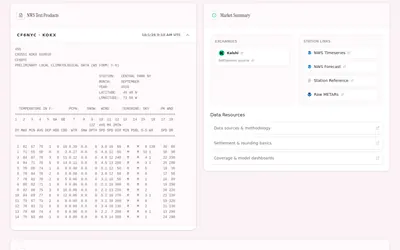
Weather-contract research organized by observation station, market date and settlement references.
- Access Web
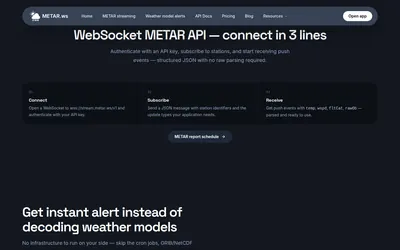
Stream airport reports and station-level model signals for weather research without building a GRIB parsing pipeline.
- Access API
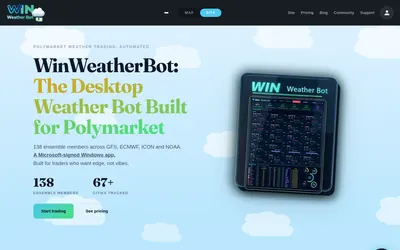

A Windows temperature-market scanner and bot with station mapping, exposure caps and configured volatility/drawdown stops.
- Trading mode Live automation
- Access Windows
Frequently asked questions about Weather Edge
Is Weather Edge a trading terminal?
The reviewed service describes weather research and email signals, not order entry.
Which models are used?
GFS and ECMWF ensembles with an NWS adjustment.
Are all cities covered?
No. The page lists a defined set of US cities.