 PredictionToolkit

What is Simmer?
Skills define market selection and strategy behavior, while account-level trade, daily and drawdown caps sit outside the strategy’s own decisions. The workflow starts with play money and keeps live-wallet linking separate. The provider says the signing key remains with the agent, and trade records expose the reasoning attached to its decisions.
The provider lists CLI agents, ClawHub and MCP access, with Polymarket, Kalshi, Hyperliquid and simulated markets in the venue coverage. Pro labels apply to Autoresearch experiments using a holdout split and filtered real-time whale or copying signals delivered to the agent. This profile covers the hosted skill platform; the developer SDK is a separate offering.
Who it is for
- For developers running research agents and users adapting a documented skill to their own configuration.
- For researchers comparing an agent’s reasoning, simulated decisions and settled results.
Features and coverage
- Catalog and skill builder
Install a strategy skill or describe an idea to generate configuration and a trading script, then inspect how it selects markets and executes.
- Paper start and external caps
Use play money before live-wallet linking, apply account-level trade, daily and drawdown caps and inspect decision records. Local signing is described as keeping the key with the agent.
- Pro experiments and signals
Autoresearch uses a holdout split to assess experiments; Pro signals deliver filtered whale and copying activity to the agent. Subscription and execution costs require account-level confirmation.
Workflows with Simmer
Read before running a skill
Inspect market universe, trigger, sizing, exits and dependencies, then keep the default dry-run or play-money mode while reviewing decisions.
Compare a generated variant
Describe the change, inspect generated files and compare simulated decisions with the original configuration.
Separate live activation
Set account caps, verify the wallet and inspect the activation boundary before separately allowing live orders.
Pricing and total cost
The provider describes catalog skills as free to install. Autoresearch and real-time signals are marked Pro; the reviewed materials do not establish a complete current subscription or execution charge, so check the account terms.
Getting started
Before you start: Simulated and live venues are separate modes. Changes to the model or configuration can change market selection and decisions.
- Choose an agent and CLI, ClawHub or MCP integration, then read the skill and its dependencies.
- Keep dry-run or play money, set limits and inspect reasoning and simulated positions.
- Link a wallet only for a separately chosen live workflow after reviewing activation and costs.
Installing a skill does not demonstrate that its strategy works in your configuration.
Useful links
What to check
- Simulated and live venues are separate modes. Changes to the model or configuration can change market selection and decisions.
A closer look
Ratings & reviews
User reviews 0
The main score switches to user ratings after 5 published reviews.
A specific example helps the next person choose the right tool.
Related tools
Browse category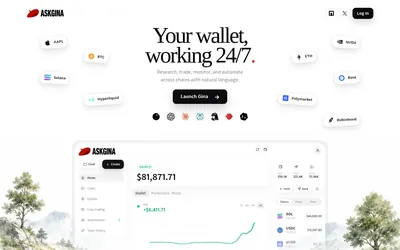

Research markets conversationally, use supported order workflows and schedule wallet tasks with explicit access choices.
- Access Web · MCP
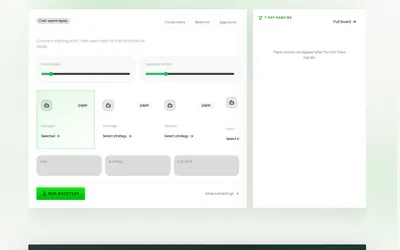

Develop prediction-market rules with explicit costs, risk limits, historical replay and a paper stage.
- Trading mode Paper · Live automation
- Access Web
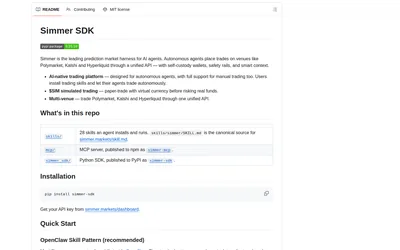
Develop agent strategies with research, paper trading, replay and supported live integrations.
- Language Python
- Access CLI
Frequently asked questions about Simmer
Is this the developer SDK?
This profile covers the hosted skill platform; the underlying SDK has a separate profile.
Where does signing happen?
The provider describes local signing with the key remaining with the agent.