 PredictionToolkit

What is Polymarket Data API?
A wallet view needs more than a total P&L: connect positions to their outcomes, retain trade side, price, size and timestamps, and show open exposure separately from closed results and turnover. Holder pages are outcome-specific, so group them by asset ID rather than pooling unrelated holders.
Rankings require an explicit period and metric. The saved public v2 sample used a data/pagination envelope; a successful limit=1 page also had more results. That narrow observation does not validate wallet accounting, every endpoint or private order state.
Who it is for
- Wallet and portfolio dashboard developers.
- Researchers studying public participation.
- Applications reconciling positions and trade history.
Features and coverage
- Positions and activity
Read public exposure and activity for portfolio reconciliation.
- Trade records
Use side, price, size, outcome, wallet and timestamp.
- Outcome holders and P&L
Merge holder pages by asset ID. includePnl needs one condition and page size at most 100.
- Open interest and volume
Request up to 20 condition IDs or global open interest; distinguish event live volume from wallet turnover.
- Resolution state
Inspect status, payouts and update time. expected_settlement_time is an earliest estimate, not a deadline.
- Trader and builder rankings
Read trader standing plus builder volume and active users. Unranked wallets can have no standing. Defaults are a day period and P&L ranking.
- Pagination and types
Follow each endpoint’s envelope and cursor. Use SDK types where available and inspect raw fields for new properties.
- Saved v2 response shape
The sample exposed data and pagination (limit, offset, has_more, next_cursor), with user_id, rank, pnl, volume and user_name rows, unlike Gamma market records.
Workflows with Polymarket Data API
Build a wallet view
Fetch positions and activity, join token or condition IDs to Gamma, and separate open exposure, closed results and turnover.
Study participation
Fetch trades and holders for a condition, group by asset ID and add open interest.
Compare rankings fairly
Use the same period and metric; preserve ties and unranked results rather than treating absence as zero.
Import complete ranking pages
Store time_period and metric, read data rows and retain the opaque cursor; one successful row does not prove complete coverage.
Pricing and total cost
No separate Data API subscription is listed in the reviewed guide. Public analytics and authorized account operations have different access requirements.
Getting started
Before you start: Do not pool holder records across unrelated outcomes.
- Read the public-analytics and wallet-activity guides and choose a query.
- Handle response envelopes and pagination, then join stable metadata IDs.
- Use SecureClient only for account operations requiring authorization.
Holder pages belong to individual outcomes; merge by asset ID.
Useful links
What to check
- Do not pool holder records across unrelated outcomes.
- includePnl requires one condition and page size ≤100.
- Choose the leaderboard period explicitly; defaults are day and P&L.
- Settlement estimates are not deadlines; inspect status and payouts.
- The saved one-page check does not validate accounting, every schema, full pagination or private orders.
A closer look
Ratings & reviews
User reviews 0
The main score switches to user ratings after 5 published reviews.
A specific example helps the next person choose the right tool.
Related tools
Browse category

Replicate fills, positions and balances for custom analytics, applications and alerts.
- Access API · CLI
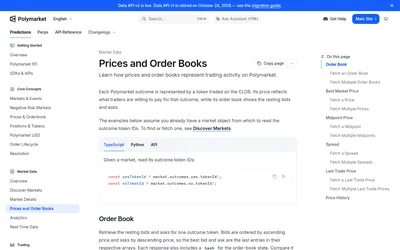

Read outcome prices and depth, then handle authenticated orders through a separate signing boundary.
- Access API
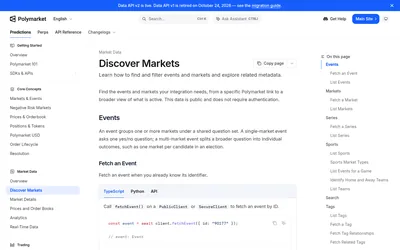

Discover contracts and their identifiers before querying executable prices or building a searchable catalog.
- Access API
Guides and workflows
Frequently asked questions about Polymarket Data API
Can Data API submit orders?
Use CLOB for trading operations.
How does it differ from Gamma?
Gamma describes events and markets; Data API covers positions, activity and participation.
Is one response the full history?
Follow documented pagination until the requested range is complete.
Does limit=1 mean one ranked trader exists?
No. The saved response included has_more and next_cursor, identifying a page rather than the full population.