 PredictionToolkit

What is Myriad?
An order-book market matches resting orders off-chain and settles them on-chain; an AMM uses a different liquidity path. Select the model before comparing fees or controls. The web app documents fill-or-kill market orders that require a full fill, while API and CLI also support fill-and-kill partial execution. A limit order that fills immediately receives taker treatment.
Search crypto, politics, finance and other topics, then read the market Rules, closing time and resolution source. Ordinary resolved winners can be claimed from the portfolio. Voided markets instead use the position’s market value at cancellation, which may differ from the original stake. Perpetual Sentiment Markets are another format: they track opinion and never resolve.
Who it is for
- Users comparing another on-chain event-trading venue.
- Liquidity providers placing resting limit orders.
- Builders integrating event markets into applications or agents.
Features and coverage
- Topic and market discovery
Search and sort crypto, politics, finance and other market topics.
- Order-book depth
Inspect bids, asks and available liquidity before choosing immediate or resting execution.
- Market and limit controls
Use full-fill web market orders or resting limit orders with cancellation and partial-fill handling. API/CLI additionally support fill-and-kill.
- Outcome split and merge
Create paired outcomes from collateral or merge the pair back into collateral.
- Portfolio claims
Claim resolved winning positions through the portfolio’s claimable section.
- Maker rebate program
The order-book program allocates taker fees to makers under its stated rebate schedule.
- API, CLI and SDK
Build data and order workflows through the API, command line or JavaScript SDK.
- Perpetual sentiment format
Track opinion in separate Sentiment Markets that do not resolve like ordinary event contracts.
Workflows with Myriad
Choose the market model
Identify AMM versus order book before comparing execution behavior and costs.
Provide resting liquidity
Place a resting limit order and monitor partial fills, rebates and resulting inventory.
Claim a resolved outcome
Read the rules, wait for resolution and use the portfolio’s claimable positions section.
Pricing and total cost
Order-book taker fees peak at 1.5% at a 50-cent price and decline linearly toward the extremes. Makers pay no trading fee, and the launch program allocates 100% of taker fees to maker rebates. AMM and Spotlight markets have separate schedules; Spotlight is listed at 0% or 0.2%.
Getting started
Before you start: Resting versus immediate execution determines maker or taker treatment, including for limit orders.
- Choose a market and read Rules, market model, closing time and resolution source.
- Create and fund the account through a supported route, then select immediate or resting execution.
- Review fees and full-fill requirements, monitor positions and claim eligible outcomes after resolution.
A limit order filled immediately is a taker order.
Useful links
What to check
- Resting versus immediate execution determines maker or taker treatment, including for limit orders.
- Web market orders require a complete fill; API/CLI also offer fill-and-kill partial execution.
- A void uses the open position’s market value at cancellation, which can differ from the original stake.
- Perpetual Sentiment Markets never resolve and should not be valued as ordinary $1-at-expiry outcome shares.
A closer look
Ratings & reviews
User reviews 0
The main score switches to user ratings after 5 published reviews.
A specific example helps the next person choose the right tool.
Related tools
Browse category

Shared liquidity, event data and developer tools for independent prediction and sports-betting applications.
- Access API
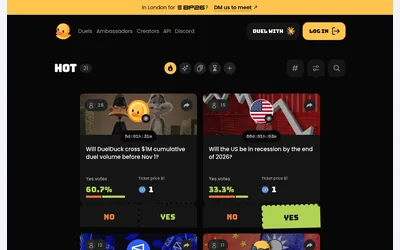

A separate Solana prediction venue for community-created yes/no duels and embeddable event questions.
- Access Web
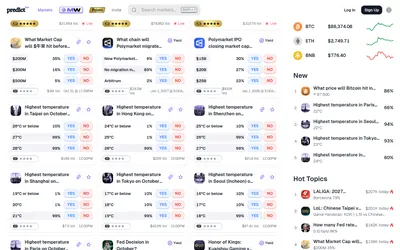

A BNB Chain prediction venue combining order books with variable Venus yield on eligible collateral.
- Access Web · API
Frequently asked questions about Myriad
Can I sell before resolution?
Yes, while the market remains open and liquidity is available.
Does every market use an order book?
No. Myriad also has AMM markets, with different execution and fee schedules.
Does a void always refund the original stake?
The documentation specifies market value at cancellation, which can differ from what was originally paid.
Where are winnings claimed?
Use the portfolio’s claimable positions after the market resolves.