 PredictionToolkit

What is Codex Prediction Markets API?
A screener can filter category, status, volume or liquidity, then rank on a selected activity window. Short and long windows cover trade counts, unique traders and changes in liquidity or open interest. Query only the fields and date ranges required, preserving venue-prefixed IDs rather than replacing them with titles.
Chart and trader-page recipes combine OHLC/volume bars with trader statistics, market-level activity and holder data. Events remain groups of markets, not interchangeable outcome records. The service provides analytics; order execution needs another integration.
Who it is for
- Market-discovery and event-page developers.
- Teams ranking recent market activity.
- Researchers joining wallet and market performance.
Data and API methods
- Event and market filters
Select category, status, volume, liquidity and ranking metrics.
- Windowed activity
Compare trade counts, unique traders, liquidity and open-interest changes.
- Outcome bars
Fetch OHLC and volume with explicit IDs and ranges.
- Trader discovery
Filter volume, PnL and supported metrics and inspect market-level activity.
- Trades and holders
Query trade history, outcome-token holders and market positions.
- GraphQL recipes
Use Explorer examples for discovery, profiles, charts and event pages.
Integration tasks
Build a screener
Filter open events, sort by the intended window and fetch component markets, retaining venue IDs.
Create a trader page
Join statistics, traded markets and time-series activity to market records.
Chart both outcomes
Request bars at a defined resolution/range and label each outcome separately.
Pricing and total cost
Prediction-market endpoints require Growth or Enterprise. Confirm price and request allowance in the dashboard or sales flow before planning polling frequency.
API access and setup
- Create an account with prediction-market access and open GraphQL Explorer.
- Run discovery with the intended protocol and exact fields.
- Retain full event/market/trader IDs and add pagination, bounded windows and plan-aware limits.
Useful links
What to check
- Events and individual markets have different identities.
- IDs contain venue and network parts; titles are not substitutes.
- Execution requires a separate integration.
A closer look
Ratings & reviews
User reviews 0
The main score switches to user ratings after 5 published reviews.
A specific example helps the next person choose the right tool.
Related tools
Browse category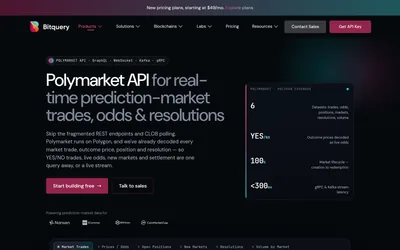

Query and stream decoded trades, token balances and settlement events.
- Access API
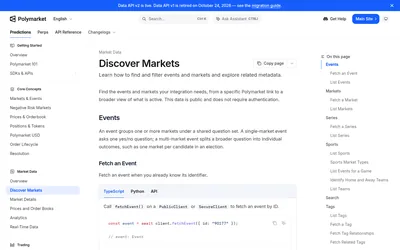

Discover contracts and their identifiers before querying executable prices or building a searchable catalog.
- Access API
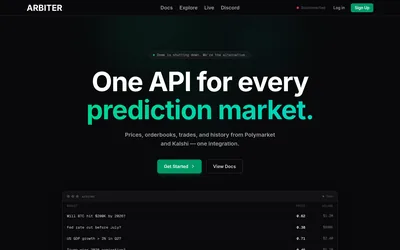

Query normalized markets, historical books, wallet analytics and possible event matches across Polymarket and Kalshi.
- Access API
Frequently asked questions about Codex Prediction Markets API
Is this OpenAI Codex?
It is the separate Codex market-data service at codex.io.
Can it cover both venues?
Polymarket and Kalshi use protocol filters and venue-specific IDs in the shared schema.
Are trader metrics included?
Statistics, trader-market activity and activity bars are documented.
Is a free plan sufficient?
The prediction-market guide specifies Growth or Enterprise.